Flip-Off vs. Peel-Style Vial Closures: Understanding the Difference
A customer question highlighted something worth explaining: not every research vial closure is designed to open the same way.
At Vial Drop Labs, some of the best opportunities to create useful educational content come directly from the questions our customers ask.
Recently, a customer contacted us after removing a vial closure and unintentionally disturbing the stopper beneath it. The customer had encountered a closure style that opened differently from the traditional flip-off cap they were accustomed to.
It made us realize something simple:
We could explain this better.
So we're starting here.
Two Closures That Work Differently
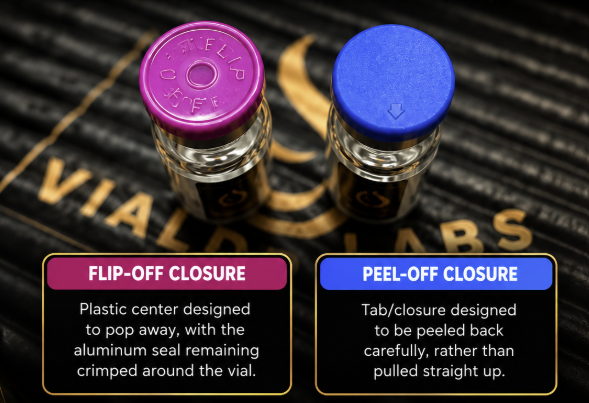
Research vials can be fitted with different closure systems. The two examples shown here illustrate a traditional flip-off closure and an alternate peel-style/removable closure.
At a glance, both incorporate a protective outer component over the vial stopper. But they are not necessarily intended to be opened the same way.
Recognizing the closure style before removing it is the important first step.
Flip-Off Closures
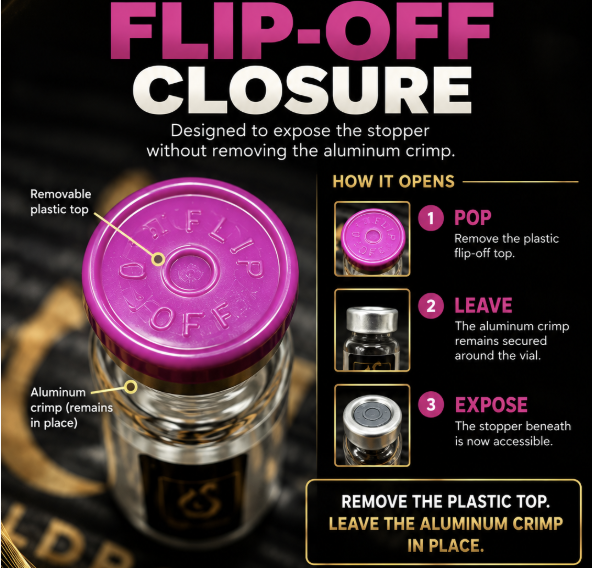
A traditional flip-off closure incorporates a removable plastic top with an aluminum crimp secured around the neck of the vial.
The plastic portion is designed to pop away, exposing the stopper beneath while the aluminum crimp remains secured around the vial.
- Plastic top comes off.
- Aluminum crimp stays in place.
Peel-Style / Removable Closure
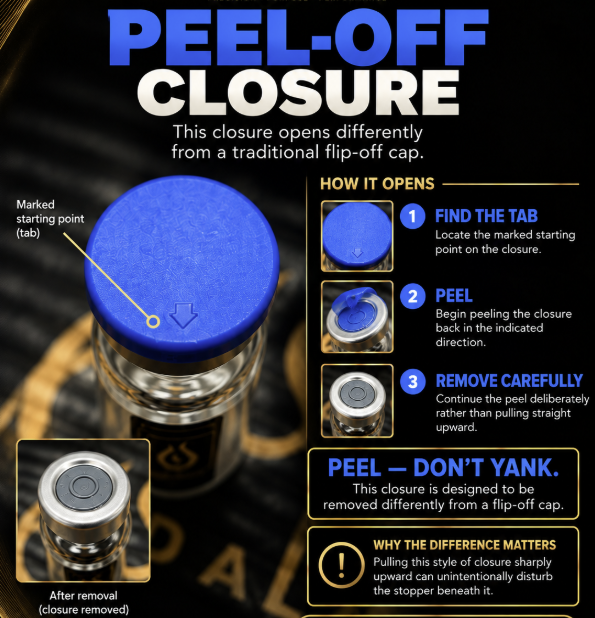
The alternate closure shown in our photographs opens differently from the traditional flip-off closure.
It includes a marked starting point on the top of the closure and is removed progressively rather than being treated like a conventional flip-off top.
Pulling this style of closure sharply upward can unintentionally disturb the stopper beneath it.
- Follow the marked starting point and remove the closure progressively rather than pulling sharply upward.
A note on terminology: Vial closure designs and terminology can vary by manufacturer. In this guide, “flip-off” refers to the closure visibly marked “FLIP OFF,” while “peel-style” is used descriptively for the alternate closure shown in our photographs.
Flip-Off vs. Peel-Style at a Glance
| Feature | Flip-Off | Peel-Style / Removable |
|---|---|---|
| Identification | Removable plastic top visibly marked “FLIP OFF” | Marked starting point on the closure |
| Initial action | Plastic top pops away | Begin at the marked starting point |
| What happens | Aluminum crimp remains secured around the vial | Closure is removed progressively |
| Key distinction | Remove the plastic top; leave the aluminum crimp in place | Remove progressively rather than pulling sharply upward |
Why We're Publishing This
This article exists because a customer asked a good question. We could have answered that customer and moved on.
Instead, the conversation highlighted an information gap that could affect other customers encountering the same unfamiliar closure. That's something we want to address differently.
Good questions make better education.
When customers ask us about vial components, analytical documentation, testing terminology, research standards, ordering, or other aspects of the Vial Drop Labs experience, those questions help us identify information that could be explained more clearly.
When we find one of those gaps, we want to close it.
We're Building a Growing Education Resource
This article is part of a broader educational initiative we're building at VialDrop.com. Our Education section will continue expanding around both fundamental research topics and the real questions customers bring to us.
- Vials, closures, and laboratory components
- Analytical testing
- COAs and analytical documentation
- Research standards and terminology
- Product information
- Ordering and fulfillment questions
Our goal isn't simply to publish more content. It's to make useful information easier to find, easier to understand, and easier to reference.
Have a Question?
Ask us. If there's something about Vial Drop Labs, our analytical documentation, research products, packaging, or processes that you'd like us to explain, send us your question. It may become our next educational resource.
Transparency isn't just publishing information. It's making information easier to understand.
Precision. Purpose. Performance.
Related research references
Educational content is provided for laboratory research understanding only. It is not medical advice and does not describe or endorse any use outside legitimate research settings.