How to Buy Research Peptides Online: A Researcher's Checklist for Quality and Documentation
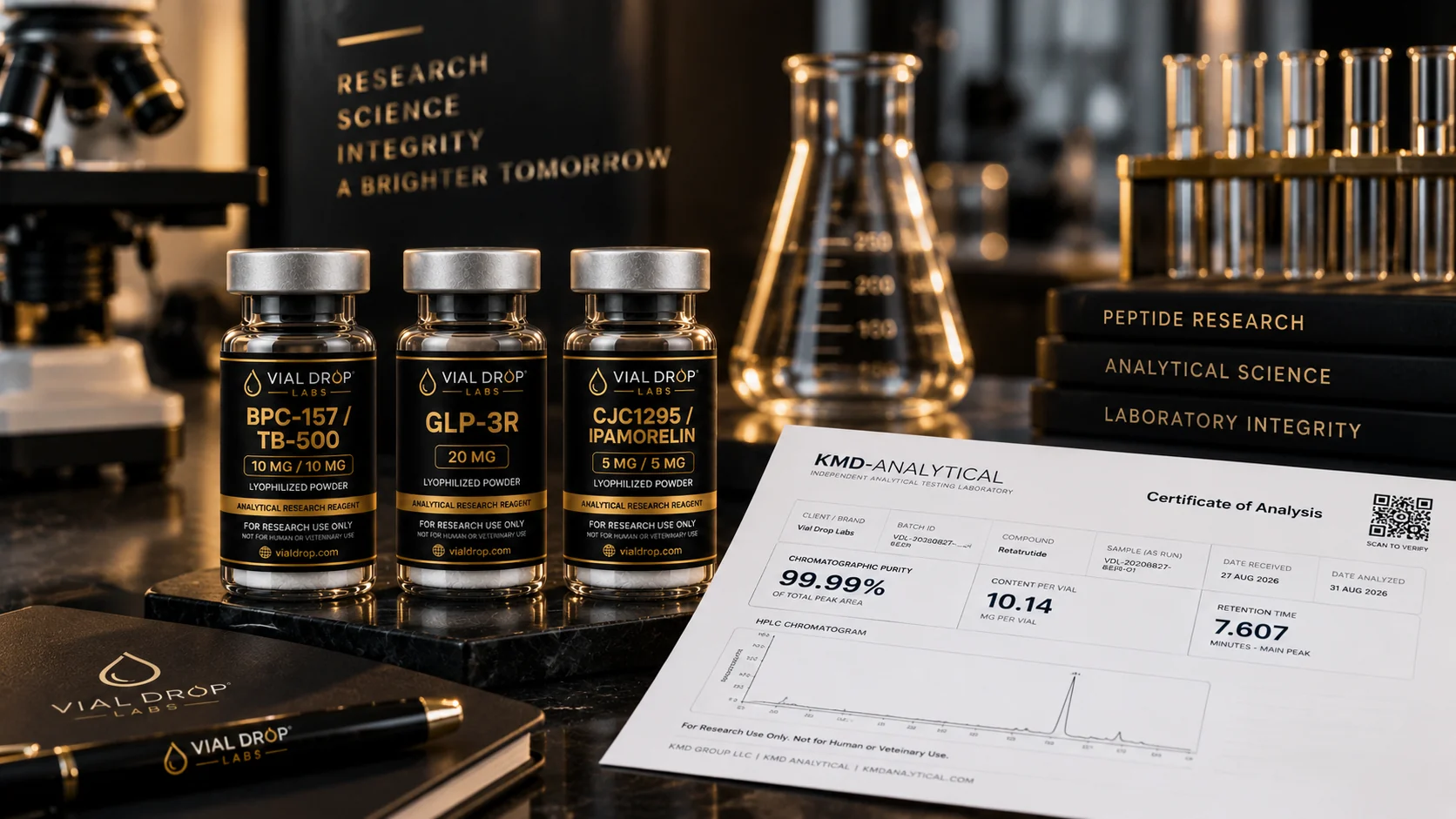
Search for research peptides for sale and you will find hundreds of listings that look nearly identical: a vial photo, a milligram count, a price. What separates a supplier you can cite in your lab notes from one you cannot is rarely the catalog page. It is the documentation behind it.
This guide is a practical checklist for buying research peptides online. It covers what to verify before you order, how to read a certificate of analysis, what good labeling and shipping look like, and the storage questions worth settling before anything arrives. The focus throughout is on compounds supplied strictly for laboratory research - not for human or veterinary use - and on the evidence that supports that framing.
Where should researchers buy research peptides online?
Research peptides should be purchased from research-material suppliers that clearly designate products for research use only, provide transparent material information, and make appropriate analytical documentation available for tested materials. Researchers should evaluate the testing source, analytical methods, sample identification, labeling, storage information, and supplier transparency before purchasing.
At a glance, the criteria below are what this guide works through in detail:
- Research-use-only positioning clearly stated
- Analytical documentation available for review where applicable
- Purity, identity, content, or other reported results clearly identified according to the testing performed
- Analytical methods and testing source identified where provided
- Testing laboratory or analytical source identified on the report
- Supplier is an identifiable business with a clear company identity
- A reasonable means of contact or research support is available
- Product labeling clearly identifies the research compound and quantity
- Shipping, storage, and handling information available
- Research-framed language without promises of consumer outcomes
Why documentation beats marketing copy
Purity claims are easy to publish and harder to independently evaluate. Documentation is different. A peptide certificate of analysis (COA) reports analytical results for the material or sample identified on the report, giving researchers information that can be evaluated beyond a product description or headline purity claim.
For researchers, that context matters. A COA can provide information such as sample or batch identifiers, reported purity, analytical methods, testing dates, and other measured characteristics depending on the scope of the analysis. The important question is not simply whether a supplier displays a COA badge, but what the underlying documentation actually shows.
How should a research peptide supplier be evaluated?
A research peptide supplier is best evaluated on what can be checked rather than what is claimed: whether research-use-only positioning is explicit, whether analytical documentation is available and identifies the material and method it represents, and whether labeling, storage, shipping, and material information are clear before an order is placed.
Three practical identity questions are easy to overlook. Does the analytical report identify the testing laboratory or analytical source? Is the supplier an identifiable business rather than an anonymous storefront? Is there a reasonable means of contact or research support if a question about documentation comes up? None of these factors independently establishes anything about the material itself, but together they determine how much of a supplier's presentation can actually be verified.
Step 1: Confirm the research-use-only positioning is explicit
Before anything else, check that the supplier states its positioning clearly and consistently. Product listings should make clear when compounds are offered for research use only and are not intended for human or veterinary use. That framing should be readily visible rather than obscured by consumer-oriented claims.
Clear research framing helps distinguish a catalog built around laboratory research from one marketed around consumer outcomes.
Step 2: Read the certificate of analysis like a researcher
A COA should give you enough information to understand what material was analyzed, what testing was performed, and what the reported results actually establish.
What should researchers look for in a peptide COA?
- Which material does it cover? Look for available batch, lot, sample, certificate, or report identifiers that help connect the analytical documentation to the material represented by the supplier.
- What was tested? Determine whether the report addresses chromatographic purity, identity, content, or other analytical characteristics. Do not assume that one test establishes characteristics it was not designed to measure.
- Which method was used? HPLC is commonly used for chromatographic purity analysis, while methods such as mass spectrometry may be used to provide evidence supporting molecular identity. Other analytical approaches may also be used depending on the laboratory, compound, and purpose of the test.
- When was it tested? Testing and report dates provide useful context for understanding when the analysis was performed.
- Who performed the analysis? Look for a report that identifies the testing laboratory or analytical source rather than referring only to an unnamed third party.
A purity percentage is more informative when the documentation identifies the analytical method, the material or sample represented, and relevant testing information. Missing information does not automatically invalidate an analytical report, but it limits what can independently be concluded from that document.
Independent analytical documentation can provide additional separation between the commercial seller and the laboratory generating the analytical result. Regardless of who performs the analysis, researchers should evaluate what was actually tested and what the reported method reasonably supports.
For a deeper walkthrough of the fields, methods, and limitations found in analytical reports, see our guide to reading a peptide Certificate of Analysis (COA).
What does a peptide COA not establish?
An analytical report describes the sample submitted and tested. It does not establish characteristics of untested material, demonstrate safety, or establish suitability for any particular use.
That scope is why results are not extrapolated between materials or strengths, and why an analytical method should only be read as evidence of the characteristic it was designed to measure.
Step 3: Check how the supplier presents purity and identity data
Good suppliers make analytical documentation accessible and provide enough context for researchers to understand the testing associated with the compounds they are evaluating. A useful exercise is to open three or four unrelated product pages - say GLOW 70 mg, GHK-Cu 100 mg, and MOTS-C 10 mg - and compare how analytical and research information is presented. As an example of publicly accessible analytical documentation, Vial Drop Labs makes its available analytical reports reviewable in a research documentation portal rather than only citing purity figures on product pages.
Look for clarity and transparency rather than assuming every compound or analytical report must contain an identical set of tests. Testing scope can differ by compound, sample, laboratory, and analytical objective, which is why a supplier's analytical documentation standards should explain what its reports contain and what they do not establish.
For multi-peptide blends, check that the formulation clearly identifies the amount of each component rather than presenting only a combined total. A blend such as BPC-157 / TB-500 should specify the milligrams of each peptide so the composition and ratio being represented are clear.
Step 4: Evaluate labeling, vial format, and shipping
Labeling is a documentation surface too. A research-compound vial should provide enough information to identify the compound and quantity and clearly communicate its research-use-only positioning. Where a supplier provides matching batch, lot, or other traceability identifiers on both the physical material and associated documentation, those identifiers can offer an additional connection between the material and its documentation.
On format, many research peptides are supplied as lyophilized powders, which can offer practical stability advantages compared with material already in solution. Shipping practices are worth reviewing as well. Packaging, dispatch time, environmental considerations, and the characteristics of the particular compound can all affect how research material should be transported.
Ask how orders ship and how they are packed before you buy, not after.
Step 5: Look for education, not hype
The clearest signal of a research-focused supplier is how it handles claims. A supplier aiming at researchers explains the research context surrounding a compound without turning preliminary or preclinical findings into promises about outcomes.
Read a supplier's blog or resource pages and watch how it talks about a compound's research areas. Language such as "studied in preclinical research involving tissue-repair pathways" identifies a research context without promising a particular result. Consumer-oriented outcome claims are fundamentally different from describing what researchers have investigated.
Step 6: Handle storage and reconstitution questions up front
Storage questions are easier to resolve before an order ships than after. Research peptides can differ in their storage requirements depending on the compound, physical form, packaging, and other factors.
Review the supplier's compound-specific storage information and any relevant analytical or product documentation rather than assuming one storage condition applies universally across a peptide catalog.
If a research protocol requires preparation of material before analysis, establish the appropriate laboratory procedure, materials, and handling conditions in advance according to the requirements of the experiment and applicable documentation.
A supplier that publishes clear storage and handling information gives researchers useful context for maintaining the material appropriately. Treat that guidance as part of the product information, not a footnote.
Red flags worth acting on
Questions are warranted when analytical documentation is unavailable or unclear, purity claims appear without information about how they were generated, research-use-only positioning is vague or inconsistent, consumer outcome claims are mixed into a research catalog, or support cannot explain what analytical documentation is available for a compound.
No single missing field necessarily determines the credibility of an entire supplier. Instead, consider the documentation as a whole: what information is available, what can be independently evaluated, and what remains unknown.
Where to start
If you are new to this space, start narrow. Pick one or two compounds, review the available analytical documentation, and understand what was tested before you buy. That habit will tell you more about a supplier than simply comparing homepage claims or headline purity percentages.
Vial Drop Labs makes independent analytical documentation available for research compounds where applicable and maintains explicit research-use-only framing throughout its catalog, from single compounds such as NAD+ and CJC-1295 / Ipamorelin to multi-peptide blends such as GLOW 70 mg. Our research library collects the compound-specific pages in one place if you would rather browse by material. All products are offered strictly for research use only and are not intended for human or veterinary use.
Related research references
How to Read a Peptide Certificate of Analysis (COA)
A field-by-field walkthrough of purity, identity, methods, and traceability.
Analytical Documentation Standards
What Vial Drop Labs reports contain, how results are presented, and what they do not establish.
Research Documentation Portal
Review available independent analytical reports by research material or SKU.
Educational content is provided for laboratory research understanding only. It is not medical advice and does not describe or endorse any use outside legitimate research settings.