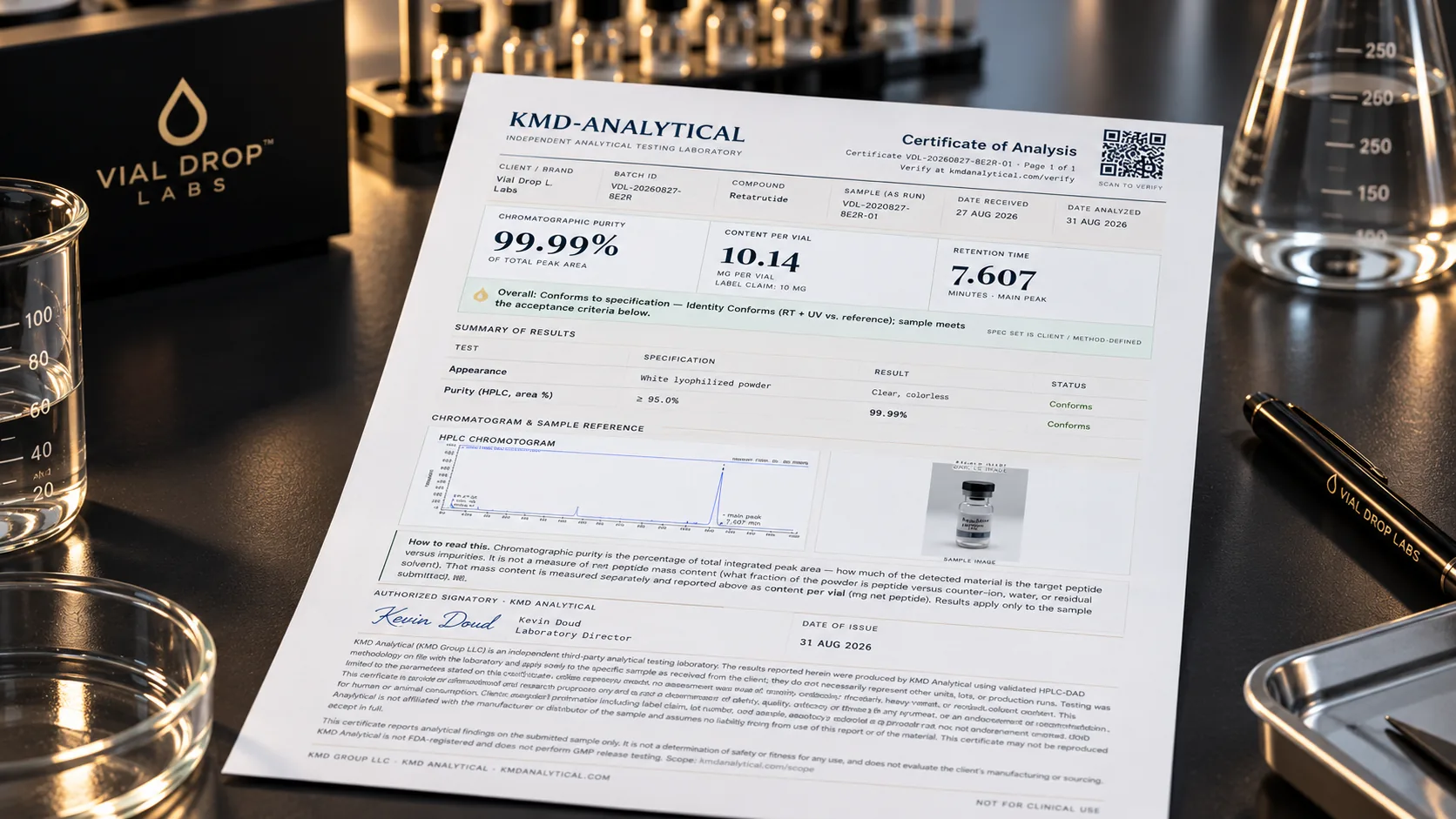
A peptide certificate of analysis (COA) is one of the most useful documents a researcher can review when evaluating a compound. It is also one of the most frequently skimmed and least frequently read line by line. Most researchers check a purity percentage, nod, and move on. That can be a mistake, because some of the most useful information lives in the details around that number: who ran the test, what material or sample the report identifies, which method was used, and what the data actually shows.
This guide walks through a peptide certificate of analysis the way a careful researcher would read it, section by section, and explains what strong analytical documentation can look like versus what should prompt additional questions before you buy research peptides online.
What a Certificate of Analysis Actually Is
A COA or analytical report documents test results and measured characteristics for the material identified on the report. Depending on the scope of testing, that may include purity, identity, or other analytical characteristics.
That distinction matters. A certificate should be evaluated based on what was actually tested and what the reported analytical method can establish. A purity result, for example, provides information about purity under the stated analytical conditions; it should not automatically be interpreted as evidence for characteristics the test did not measure.
Lot, batch, sample, or report identifiers can provide additional traceability between analytical documentation and the material represented by a supplier. When those identifiers are available, researchers should review them alongside testing dates and other report information.
Vial Drop Labs makes analytical documentation available for research compounds where applicable, allowing researchers to review reported analytical results rather than relying solely on product descriptions or headline purity claims. Our analytical documentation standards describe what those reports contain and what they do not establish.
The Fields Worth Reading Slowly
1. Compound identity and sequence
For a peptide, identity is more than a marketing name. Peptides can be described by a full chemical or compound name, molecular formula, molecular weight, amino acid sequence, or structural description, depending on the compound and analytical report.
These details can help distinguish the intended peptide from related analogs, fragments, or compounds that may share similar abbreviations.
Peptide identity can be evaluated using analytical techniques such as mass spectrometry, which compares an observed molecular mass with an expected value. Agreement between observed and expected mass provides evidence supporting molecular identity within the scope and limitations of the method.
When identity testing is reported, look at both the expected value and the analytical result rather than simply checking whether the compound name appears at the top of the page.
2. Purity percentage — and how it was measured
Purity is often the headline number on a peptide COA, commonly expressed as a percentage generated using high-performance liquid chromatography (HPLC).
But the percentage becomes considerably more useful when you understand the method behind it.
Read for:
- The analytical technique used, such as RP-HPLC
- Relevant method information provided by the laboratory
- The reported purity result
- Supporting analytical data, such as a chromatogram, when provided
A chromatogram can provide additional context for reviewing an HPLC purity result. However, laboratories differ in how much underlying method and instrument information they include on a customer-facing certificate or summary report.
The important question is not whether every COA follows one universal format. It is whether the documentation clearly communicates what was tested, what result was obtained, and what that result reasonably supports.
3. Reported purity versus reported peptide content
Reported purity and reported peptide content are two different measurements, and a report can state both without either standing in for the other.
Reported chromatographic purity describes the relative chromatographic composition represented by the reported method and result — for an area-percent HPLC result, how much of the detected chromatographic response is attributable to the peak identified as the target peptide under the stated conditions.
Reported peptide content per vial addresses a different question: the measured quantity of peptide reported for the submitted sample, usually stated in milligrams and read against the label claim.
A high reported purity percentage does not, by itself, establish that the vial contains the labeled quantity. A sample can be chromatographically clean and still be reported at a quantity above or below label claim, because purity is a proportion and content is an amount.
The reverse is equally true. Measured content close to label claim does not replace identity or purity analysis, because a quantity result does not describe what else the chromatogram detected or confirm which molecule was measured.
Read each result against what the reported method was designed to establish, and treat both as applying to the sample the laboratory analyzed rather than to material the report does not identify.
4. The analytical method and instrumentation
Method detail provides context for interpreting a result.
A well-documented analytical report may identify the assay performed, analytical technique, instrument class, test conditions, or other parameters used by the laboratory. The amount of detail provided can vary depending on the laboratory and report format.
Different analytical techniques can also answer different questions.
For example, HPLC may characterize chromatographic purity, while mass spectrometry can provide evidence supporting molecular identity. When complementary analytical methods are available, researchers can evaluate each result according to what that particular method measures. Our comparison of HPLC and mass spectrometry covers what each technique is and is not designed to answer.
This is an important distinction: a COA should not be expected to prove characteristics that were never tested.
5. Testing laboratory and independence
Who performed the analysis is useful context when reviewing analytical documentation.
Independent analytical testing means the laboratory performing the reported testing is separate from the party selling the material. This can provide additional separation between the commercial seller and the laboratory generating the analytical result.
When reviewing documentation, look for information identifying the laboratory or testing source, the analytical methods performed, and any report, sample, or certificate identifiers provided.
Third-party analysis can strengthen confidence in analytical documentation, but independence alone does not tell you everything about a sample. The scope and methodology of the testing still matter.
Whether documentation comes from an independent laboratory, manufacturer, or another analytical source, researchers should focus on what was tested, what the report actually demonstrates, and what remains outside the scope of that analysis.
6. Lot, batch, and sample traceability
Lot, batch, sample, and report identifiers can help connect analytical documentation to the material represented by a supplier.
Depending on the laboratory and supplier, a report may contain a batch number, sample identifier, report number, testing date, manufacturing information, or other traceability information.
These identifiers can help researchers determine which material was analyzed and compare documentation across different batches or testing periods.
When suppliers provide identifiers on both analytical documentation and physical packaging, researchers can evaluate whether those identifiers establish a documented connection between the material and the report. If the relationship between a report and a product is unclear, asking the supplier for clarification is more informative than assuming the documentation applies — or does not apply — based on one missing field.
A report associated with a research material is not the same as vial- or lot-level traceability. That level of traceability requires identifiers that establish a documented connection between the physical material and the analytical report.
Traceability is valuable because analytical results are most useful when researchers can understand what material the reported testing represents.
7. Appearance, form, and handling notes
This section is easy to skip and can still contain useful information.
A certificate or accompanying product documentation may describe physical appearance, form, storage recommendations, or handling information. A lyophilized peptide, for example, may be described by its expected physical appearance along with recommended storage conditions.
It is important, however, to distinguish analytical test results from descriptive or recommended information.
A storage recommendation does not necessarily mean the analytical laboratory independently tested stability under every listed condition. Likewise, a description of physical appearance should not be interpreted as a substitute for analytical identity or purity testing.
Understanding which information was measured and which information is provided as product guidance is part of reading a COA carefully.
COA Fields at a Glance
Each field on an analytical report answers a narrow question. The table below summarizes what a field can support and what it does not establish on its own.
| COA field | What it can tell you | What it does not establish by itself |
|---|---|---|
| Material / sample identity | Which material the laboratory received and analyzed, as described on the report. | That any other vial, package or shipment is the same material as the one analyzed. |
| Issuing laboratory | Who performed the analysis, and whether that party is separate from the seller. | The scope, method or quality of the analysis, which must be read from the report itself. |
| Certificate / report ID | A unique reference for this specific report, usable when asking the laboratory or supplier about it. | That the report covers material beyond the sample it identifies. |
| Analytical method | Which technique produced the result and what characteristic that technique measures. | Characteristics the method was not designed to measure, such as identity from a purity-only method. |
| Reported purity | The relative chromatographic composition of the submitted sample under the stated conditions. | The quantity of peptide in a vial, or any characteristic outside the reported method. |
| Reported content | The measured quantity of peptide reported for the submitted sample against label claim. | Identity or purity, which require their own analysis. |
| Analysis date | When the reported testing was performed, giving the result a point in time. | The condition of material at any later date, or stability over time. |
| Sample / batch identifier | Which sample the laboratory analyzed, and lets reports be distinguished from one another. | Customer vial-to-report traceability, unless corresponding identifiers connect the physical material to that report. |
| Independent verification record | That the issuing laboratory maintains its own record of the certificate, viewable outside the seller's website. | Anything beyond the contents of that report, including results for material it does not identify. |
Example: Reading a Published Analytical Report
The fields above are easier to follow against a real report. The record below is one of the published Vial Drop Labs analytical reports, shown exactly as it appears in the Research Documentation portal.
- Research material: GLP-3R 10 mg
- Issuing laboratory: KMD Analytical
- Analytical method: HPLC (area %)
- Reported purity: 99.99%
- Reported content per vial: 10.14 mg
- Date analyzed: 2026-08-31
- Certificate ID: VDL-20260827-8E2R-01
What this example demonstrates:
- Reported purity and reported content per vial are two separate results, produced by the reported method and read separately.
- The report has an identifiable issuing laboratory rather than an anonymous testing source.
- The certificate carries a unique identifier that distinguishes it from other reports.
- The analytical report itself is accessible, not merely summarized in a product description.
- The issuing laboratory maintains an independent verification record for the certificate identifier.
These reported results apply to the submitted sample represented by the analytical report and should not be interpreted as testing of every vial or production unit.
View analytical report → the GLP-3R 10 mg certificate in the Research Documentation portal.
View the GLP-3R research reference for the compound-level information that accompanies the report.
Verify with the issuing laboratory: KMD Analytical publishes an independent verification record for this certificate identifier.
What Should Raise Questions
The most useful way to evaluate analytical documentation is not to apply a rigid checklist to every certificate. Laboratories, manufacturers, and analytical providers can use different report formats.
Instead, look at what information is available — and recognize what remains unknown.
Questions worth asking include:
- What material, batch, or sample does the report identify?
- What analytical method was used?
- What characteristic does that method measure?
- Is the laboratory or analytical source identified?
- Is a testing or report date provided?
- Are supporting analytical data provided where applicable?
- Can the documentation reasonably be connected to the product being represented?
Missing information does not automatically invalidate a report. It does, however, limit what can independently be concluded from that particular document.
The key is to avoid treating the presence of a COA — or a large purity percentage printed on one — as a substitute for understanding the analytical evidence itself.
How to Use a COA in Practice
Reading a certificate of analysis is a short exercise in verification.
Start by identifying the compound and reviewing any available lot, batch, sample, or report information. Look at the analytical method used and determine what characteristic that method is intended to evaluate.
If an HPLC purity result is reported, review the percentage and any supporting analytical information provided. If mass spectrometry or another identity-focused method is included, evaluate that result separately rather than assuming one analytical method establishes everything about the sample.
Then identify the testing source and date and determine what conclusions the available documentation reasonably supports.
Doing this gives you a much stronger basis for evaluating research material than simply scanning for a “99%+” purity claim.
Vial Drop Labs publishes analytical documentation for its research compounds where applicable and keeps the research-use-only framing explicit: For research use only. Not for human or veterinary use. If you want to see how analytical documentation fits into compound-specific research information across our catalog, start with our GLOW 70 mg peptide blend, BPC-157 / TB-500 blend, and GHK-Cu 100 mg research pages.
The Bottom Line
A peptide certificate of analysis is not a badge. It is analytical documentation, and its value comes from understanding what was tested, how it was tested, which material the result represents, and what conclusions the reported method can reasonably support.
The purity number is where many researchers stop reading. The method, analytical source, supporting data, and available traceability information are where a more informed evaluation begins.
Read the whole document. Check the available details against the research material being represented. Understand what each analytical method measures — and what it does not.
When choosing where to buy research peptides online, the availability and transparency of analytical documentation can be an important quality signal. But the strongest evaluation goes beyond simply asking whether a COA exists.
Ask what the evidence actually shows.
Related research references
Buying research peptides online: a supplier checklist
What to verify before you order — documentation, labeling, shipping, and storage.
Analytical Documentation Standards
What Vial Drop Labs reports contain, how results are presented, and what they do not establish.
Research Documentation Portal
Review available independent analytical reports by research material or SKU.
Educational content is provided for laboratory research understanding only. It is not medical advice and does not describe or endorse any use outside legitimate research settings.