GLP-3R 20 mg Vials: Specifications, Analytical Verification & Research Documentation
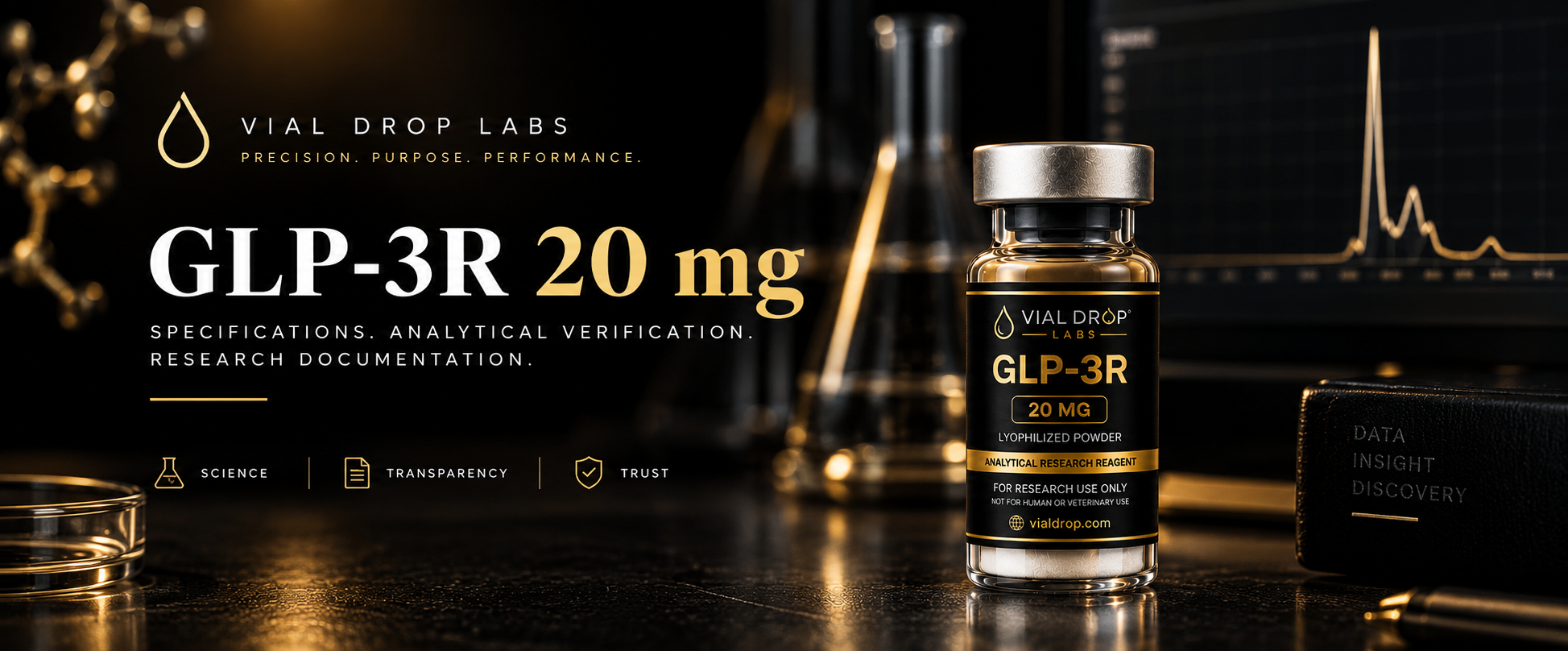
When evaluating a GLP-3R 20 mg research material, the number printed on the vial is only one part of the material's identity.
For laboratory work, researchers may also need to evaluate molecular identity, analytical purity, quantity testing, report and sample identifiers, and the scope of the analytical documentation associated with the material.
These measurements answer different questions. A chromatographic purity result, for example, should not automatically be interpreted as proof of vial quantity. Likewise, an identity result does not independently establish purity or quantity.
Understanding those distinctions is important when reviewing research materials and Certificates of Analysis.
At Vial Drop Labs, GLP-3R is the catalog terminology used for research material corresponding to retatrutide. “GLP-3R” should not be interpreted as the name of a biological receptor. Retatrutide, also identified as LY3437943, is a triagonist acting at the GIP, GLP-1 and glucagon receptors.
For research use only. Not for human consumption.
GLP-3R 20 mg Technical Profile
VDL's GLP-3R research material is offered in both 10 mg and 20 mg formats.
The scientific-development context of retatrutide is separate from VDL's research material. Vial Drop Labs supplies material strictly for laboratory research and does not present it as a drug or therapeutic product.
| Property | Specification |
|---|---|
| Research designation | GLP-3R |
| Reference compound | Retatrutide |
| Development identifier | LY3437943 |
| CAS number | 2381089-83-2 |
| Molecular formula | C221H342N46O68 |
| Approximate molecular weight | 4,731 g/mol |
| Sequence length | 39 amino acids |
| Receptor profile | GIP / GLP-1 / glucagon receptor agonist |
| VDL format discussed here | 20 mg vial |
| Intended use | Laboratory research only |
GLP-3R (20 mg)
Analytical verification
99.98%
Chromatographic purity
of total peak area
19.98 mg
Content per vial
20 mg label claim
Conforms
Identity
RT + UV vs. reference
7.499 min
Main-peak retention time
Identity
Is the analyzed material consistent with the expected compound?
Purity
What proportion of the detected chromatographic signal is attributable to the principal component under the test conditions?
Quantity
How much target material was measured in the submitted sample?
PURITY ≠ QUANTITY
Different measurements answer different analytical questions.
Documentation
- Independent laboratory
- KMD Analytical
- Certificate
- VDL-20260827-8VYD-01
- Batch
- VDL-20260827-8VYD
- Sample
- VDL-20260827-8VYD-01
- Date received
- August 27, 2026
- Analyzed
- August 30, 2026
- Overall
- Conforms to specification
Results apply to the submitted sample within the scope of the tests performed.
For research use only. Not for human consumption.
What Does Analytical Verification Actually Tell You?
One of the most important distinctions in peptide documentation is that identity, purity and quantity are separate analytical questions.
A report can provide strong evidence for one without necessarily answering the others.
1. Identity
Identity testing asks: “Is the analyzed material consistent with the expected molecular compound?”
Identity evaluation provides evidence supporting whether the analyzed sample is consistent with the expected material.
This is fundamentally different from asking how much material is present in the vial.
2. Purity
Chromatographic analysis such as HPLC separates components within a sample and can be used to estimate the relative chromatographic purity of the analyzed material.
A reported purity percentage therefore addresses what proportion of the detected chromatographic signal is attributable to the principal component under the test conditions.
It should not automatically be interpreted as: “This vial contains exactly the labeled number of milligrams.” Those are different measurements.
3. Quantity
Quantity testing addresses another question: “How much target material was measured in the submitted sample?”
This distinction matters when evaluating a vial labeled 20 mg.
A high chromatographic purity result does not, by itself, establish that the vial contains exactly 20 mg of target material. Quantity must be evaluated separately when that is the analytical objective.
Why the Difference Between Purity and Quantity Matters
The VDL GLP-3R 20 mg certificate provides a useful real-world example.
KMD Analytical reported chromatographic purity of 99.98% of total peak area and content per vial of 19.98 mg against a 20 mg label claim. These are separate analytical results.
KMD explicitly states on the certificate that chromatographic purity is not a measure of net peptide mass content and that mass content was measured separately and reported as content per vial.
This illustrates why researchers should evaluate the combination of analytical methods and exactly what each result establishes rather than relying on a single percentage displayed on a COA.
How to Read a GLP-3R Certificate of Analysis
A useful analytical report should make it possible to associate the testing with the submitted material being evaluated.
When reviewing documentation, researchers should look for:
For a broader field-by-field guide, learn how to read a peptide Certificate of Analysis using the VDL education reference.
- Identifiable sample or batch information
- Date of analysis
- Laboratory identification
- Analytical method used
- Reported result
- Sufficient supporting analytical information
- A clear relationship between the submitted sample and corresponding research material
Batch-Specific Documentation Matters
Vial Drop Labs independently tests every batch of its research materials and associates the resulting analytical documentation with the corresponding tested batch and submitted sample.
Each laboratory report identifies the applicable batch, sample, testing laboratory, analytical results, and scope of testing. This provides batch-specific documentation while recognizing that analytical results apply to the sample submitted for testing.
Individual vial labels do not display the batch identifier; batch records and analytical documentation are maintained separately by Vial Drop Labs.
The analytical report documents the results obtained for the submitted sample within the scope of the tests performed.
Vial Drop Labs GLP-3R 20 mg Analytical Documentation
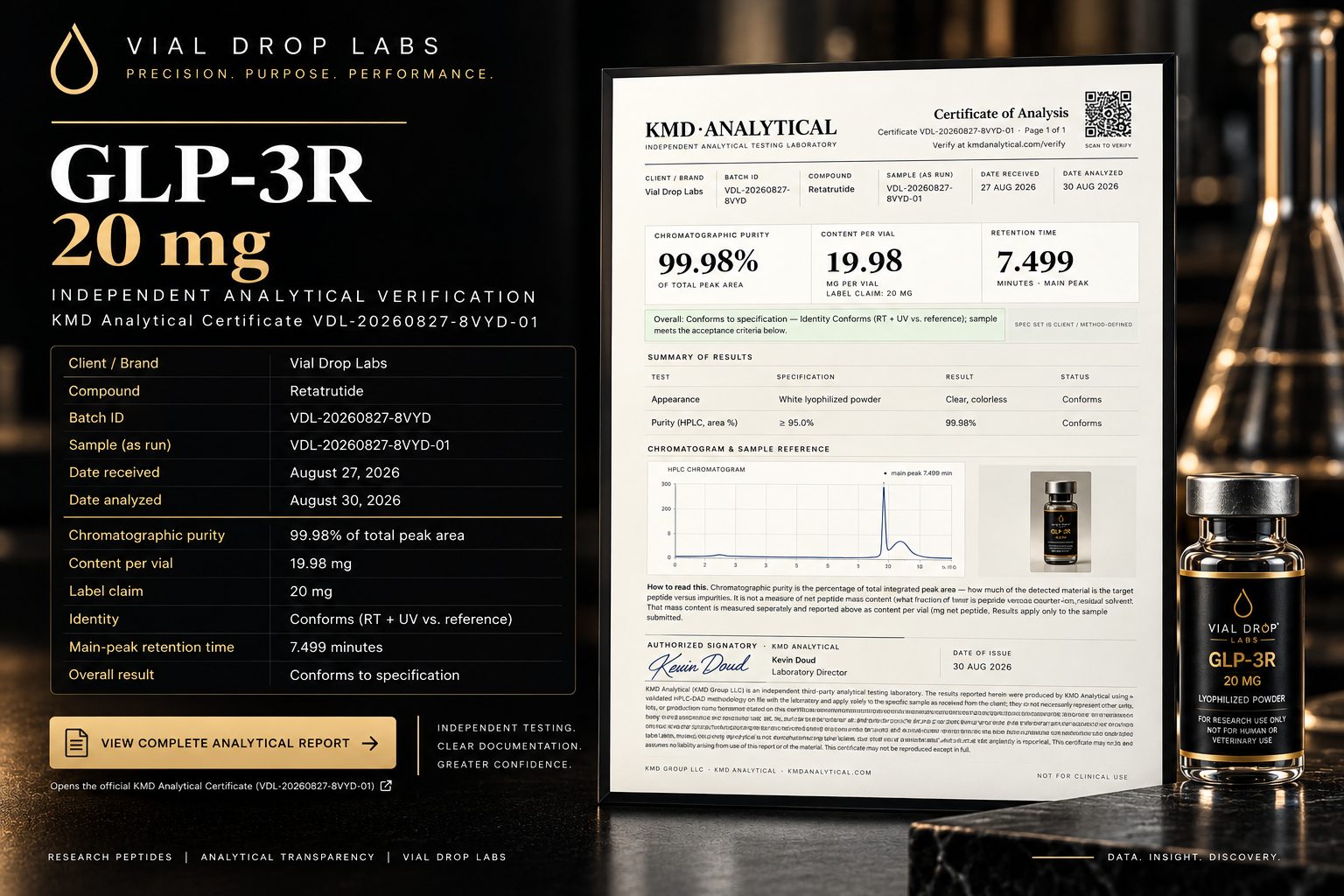
KMD Analytical · Certificate VDL-20260827-8VYD-01
View Complete Analytical ReportScope of the Analytical Report
This certificate reports the analytical parameters stated by the laboratory for the submitted sample. It should not be interpreted as testing for characteristics or parameters outside the stated analytical scope.
Parameters not reported by this certificate include sterility, endotoxin, microbial content, heavy metals, and residual solvents.
Evaluating a GLP-3R 20 mg Research Supplier
Researchers comparing suppliers can focus on objective documentation questions:
- Does the supplier clearly identify the research material?
- Can the researcher access analytical documentation?
- Does that documentation identify the laboratory and testing methodology?
- Does the supplier maintain batch-specific analytical documentation and clearly identify the tested batch and submitted sample?
- Does the supplier distinguish between purity, identity and quantity?
- Does the supplier accurately describe the limitations of its analytical testing?
- Does the supplier avoid presenting research materials as medicines?
These questions provide more useful information than relying solely on broad marketing terms such as “premium,” “pharmaceutical grade,” or “99% pure.”
GLP-3R, Retatrutide and Research Terminology
Retatrutide is a molecule identified as LY3437943. It acts as a triagonist at the GIP, GLP-1 and glucagon receptors.
The term “GLP-3” is sometimes used informally because three receptor systems are involved, but it is not the scientific name of a biological receptor.
VDL uses GLP-3R as a catalog designation. It should not be interpreted as identifying a newly discovered receptor. See the GLP-3R / retatrutide research information reference for broader compound-level context.
Frequently Asked Questions
What is a GLP-3R 20 mg vial?
Within the Vial Drop Labs catalog, GLP-3R identifies research material corresponding to retatrutide, a GIP, GLP-1 and glucagon receptor agonist. The 20 mg designation identifies the nominal vial format offered by VDL.
Is GLP-3R the name of a biological receptor?
No. GLP-3R is VDL catalog terminology. Retatrutide acts at three established receptor systems: GIP, GLP-1 and glucagon receptors.
Is chromatographic purity the same as peptide quantity?
No. Purity and quantity answer different analytical questions. A chromatographic purity percentage should not automatically be interpreted as verification of the total quantity of target material contained in a vial.
What did VDL's GLP-3R 20 mg analytical report show?
KMD Analytical reported 99.98% chromatographic purity and 19.98 mg content per vial against a 20 mg label claim for the submitted sample. Identity conformed by RT + UV versus reference.
What should I look for on a GLP-3R COA?
Look for sample or batch identification, testing date, laboratory identity, analytical methodology, reported results and supporting analytical information. Most importantly, determine exactly what the report tested rather than assuming that one test establishes every characteristic of the material.
Are Vial Drop Labs GLP-3R materials intended for human use?
No. For research use only. Not for human consumption.
Research Documentation Before Procurement
Researchers evaluating GLP-3R 20 mg material should review the analytical documentation before making a procurement decision.
Rather than relying on broad claims, evaluate the specific evidence available for the material: identity, purity, quantity, report association, and testing scope. Each answers a different question.
Vial Drop Labs publishes independent analytical reports for tested research materials so researchers can examine the available evidence directly.
View GLP-3R analytical documentation →
Explore GLP-3R research information →
View GLP-3R 20 mg research material →
For research use only. Not for human consumption.
Related research references
GLP-3R 20 mg analytical report
Review certificate VDL-20260827-8VYD-01 in the Research Documentation library.
How to read a peptide Certificate of Analysis
A field-by-field guide to identity, purity, content, analytical methods, and report scope.
GLP-3R / retatrutide research information
Review the broader compound identity, molecular data, and research reference.
Educational content is provided for laboratory research understanding only. It is not medical advice and does not describe or endorse any use outside legitimate research settings.