Multi-Peptide Blends vs. Single Compounds: Understanding GLOW 70 mg, BPC-157 / TB-500, and GHK-Cu in Research
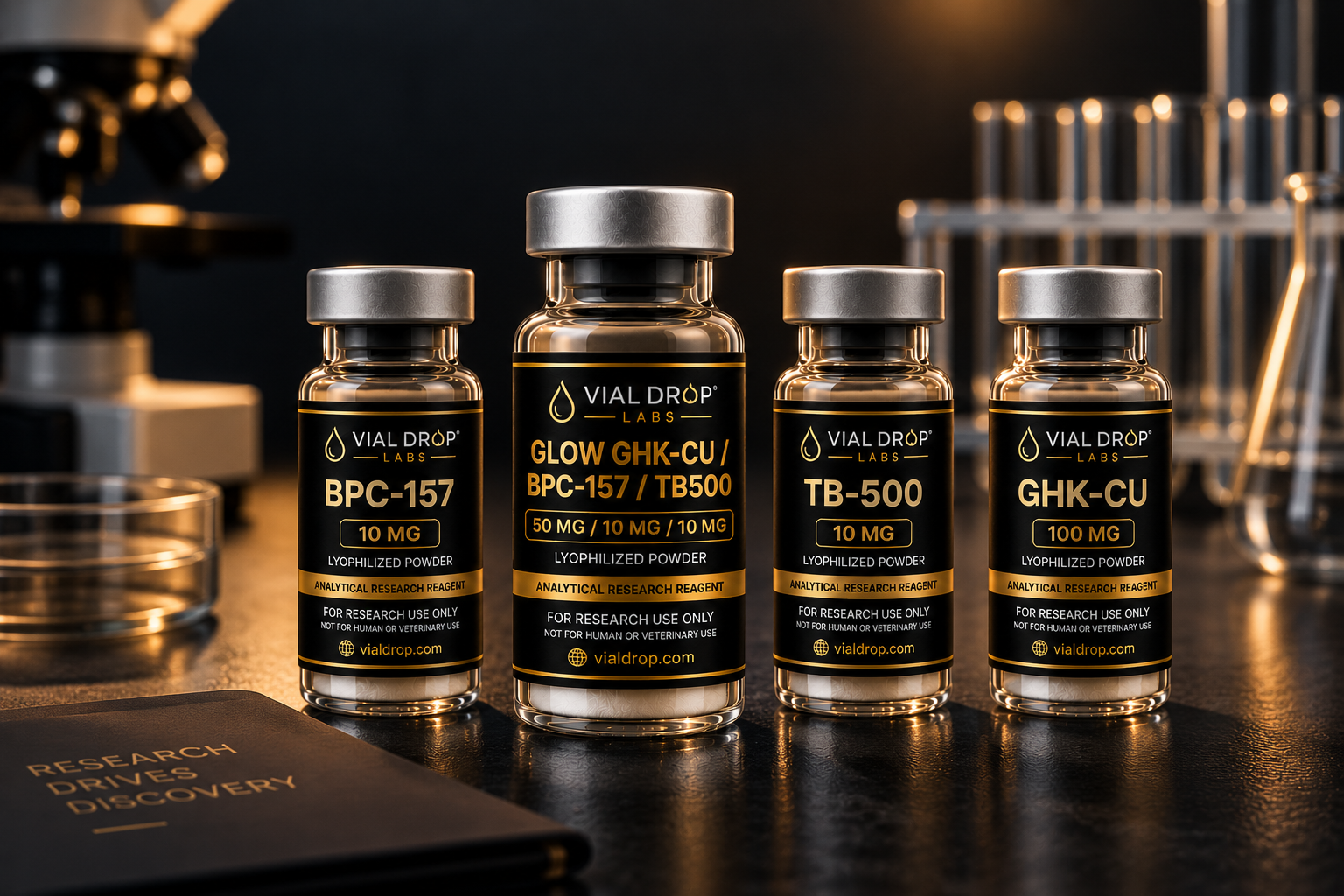
Walk through any peptide research catalog today and you will notice the shelf has split into two formats. On one side sit narrower formulations—one compound, one set of pathways, one clean variable. On the other side sit multi-peptide blends, where two or three well-studied compounds share a single research vial. Vial Drop Labs carries both, which raises a practical question for anyone designing preclinical work: when does a blend like GLOW 70 mg actually serve the experiment, and when does a narrower formulation such as BPC-157 / TB-500 or GHK-Cu 100 mg do more?
This comparison breaks down what each format is, how researchers tend to study them, and where the tradeoffs sit. All of it stays in preclinical, research-framed terms. Vial Drop Labs compounds are offered strictly for research use only and are not intended for human or veterinary use.
What a Multi-Peptide Research Blend Actually Is
A multi-peptide blend is a single formulated vial containing two or more distinct peptides in defined amounts. It is not a new compound. It is a convenience format that places compounds researchers already study separately into one controlled container.
GLOW 70 mg is a clear example. The vial combines GHK-Cu at 50 mg, BPC-157 at 10 mg, and TB-500 at 10 mg. Each of those three peptides carries its own body of preclinical literature. GHK-Cu is a naturally occurring copper-peptide complex studied in extracellular matrix biology, collagen-related pathways, and tissue remodeling. BPC-157 and TB-500 are widely investigated in research involving cellular signaling, tissue-repair pathways, angiogenesis, cell migration, and regenerative processes. Put together, GLOW gives a laboratory a single starting material for investigating three related research targets side by side.
The key word is related. Blends make the most sense when the compounds inside them are studied in overlapping or adjacent research areas, because that is when a combined formulation reduces handling steps without mixing unrelated variables.
Narrower Formulations: The Isolation-First Approach
Narrower formulations keep the experimental design focused. If a study is built to attribute an observed effect to one peptide, then one peptide is what belongs in the vial.
BPC-157 / TB-500 is itself a dual-peptide blend of BPC-157 (10 mg) and TB-500 (10 mg) in a 20 mg vial, and it is studied for the interplay between two complementary research targets. GHK-Cu 100 mg delivers the copper-binding peptide on its own, which is useful when the research question centers on copper-peptide interactions with matrix and collagen-related pathways rather than on a broader panel.
The advantage here is control. A single compound means one variable, one set of observed outcomes, and a cleaner line from input to result. The cost is throughput: running three separate single-compound arms takes more vials, more prep, and more bench time than opening one blend.
Where the Blend Format Earns Its Place
Multi-peptide blends tend to fit research questions that are explicitly about interaction rather than isolation. Consider a study asking how complementary signaling pathways behave when investigated together in a controlled setting. That is a question a blend answers naturally, because the co-formulation is the point of the design.
Three situations where a blend like GLOW 70 mg tends to make sense:
- Pathway-interaction studies. When the research hypothesis involves how GHK-Cu, BPC-157, and TB-500 behave within one controlled system, a single vial removes cross-prep variability between arms.
- Screening and pilot work. Early-stage exploration across a related panel of research targets can move faster when compounds arrive co-formulated rather than sourced and prepared individually.
- Reproducibility across a series. Working from a single predefined blend for a run of related experiments keeps the composition of the starting material consistent across the series, rather than combining separately sourced and individually prepared compounds.
Where the Single-Compound Format Wins
The single-compound vial remains the better fit when attribution matters most. If a result needs to be tied firmly to one peptide, a blend introduces ambiguity that no amount of careful design fully removes.
Single compounds are also the right call when the research question spans compounds that do not naturally share a research context. Blending compounds studied in overlapping areas is a convenience; blending unrelated ones is simply a confound. And for dose-response work on one specific compound, isolating it is the only route to a clean curve.
A Practical Framework for Choosing
Rather than treating blends and single compounds as competitors, treat them as two stages of the same research pipeline.
- Start with the question. If the design is about interaction, a blend is efficient. If it is about attribution, isolate.
- Check pathway overlap. Compounds studied in adjacent research areas combine sensibly. Unrelated ones do not.
- Match the format to the stage. Broad exploratory screening often favors a blend; focused mechanistic follow-up favors single compounds.
- Keep documentation consistent. Independent analytical documentation and sample-level transparency matter in both formats—the format changes the vial, not the standard.
For many research programs the sequence looks like this: screen a related panel with a blend such as GLOW 70 mg, then narrow to focused work on whichever target the screening points toward, using BPC-157 / TB-500 or GHK-Cu 100 mg to investigate that pathway in greater isolation.
Documentation Does Not Change With the Format
One thing that should carry across every format is how a supplier documents its material. Purity, identity, and sample-level analysis are properties of the peptide and the process behind it, not of the packaging decision. A blend is not inherently less rigorous than a single compound, and a single compound is not automatically better documented. What matters is whether independent analytical documentation is available where applicable and whether the supplier is transparent about what is in the vial and how it was characterized. Evaluating that documentation is easier with a working knowledge of how to read a certificate of analysis, since a report's fields each establish something specific about the submitted sample.
Vial Drop Labs applies the same documentation stance to GLOW 70 mg, BPC-157 / TB-500, GHK-Cu 100 mg, and the rest of its catalog, and frames every product within research-use-only positioning.
The Short Version
Multi-peptide blends and single compounds answer different research questions. GLOW 70 mg packs GHK-Cu, BPC-157, and TB-500 into one vial for work centered on related signaling and repair pathways. Single-compound vials keep the variable count at one for studies where attribution is the goal. Many research programs may use both, moving from blend-based screening into more focused compound investigation.
For research use only. Not for human consumption.
Related research references
GLOW Research Peptide Blend
Composition, component identity, and analytical approach for the three-component formulation.
BPC-157 / TB-500 Research Peptides
Chemical identity and documentation considerations for the two-component blend.
GHK-Cu Research Peptide
Copper peptide identity, molecular data, and analytical documentation.
How to Read a Peptide Certificate of Analysis (COA)
A field-by-field walkthrough of purity, identity, methods, and traceability.
Educational content is provided for laboratory research understanding only. It is not medical advice and does not describe or endorse any use outside legitimate research settings.